Studio · About
About
the studio.
FlossyPurse Studios is a creative engineering studio in Parkland County, Alberta, founded by Cully Wakelin, with agents doing a lot of the hands-on work. Below: who’s behind it, the road that led here and what each stretch taught, and what the studio has made since.
Cully
Who you would be working with.
I’m Cully Wakelin. FlossyPurse Studios is my creative engineering studio in Parkland County, Alberta. We make software, foam-dart blasters, printed parts and furniture. Before the studio, I spent years inside durable execution and developer infrastructure — at Temporal, then at Resonate — building the documentation, developer experience, SDK surfaces, and compliance programs those platforms stand on. Fifteen years of shipping software is underneath all of it, and the road below is how I got here.
- AI engineering
- Retrieval, tool use, and the pipelines that put LLM features into production.
- Building with agents
- Setting up the scope, gates and verification that decide whether the output is worth keeping.
- Distributed systems design
- Retries, recovery, and long-running work that survives a crash.
- Production diagnosis
- Finding the failure in a system that’s already running.
- Full-stack development
- Frontend, backend, database, third-party integrations.
- Technical support
- Triage, escalation, and integration work with large accounts.
- Technical writing
- Explaining a system so someone else can operate it.
- Compliance
- SOC 2 Type 1 and Type 2, control statements through to audit.
- Design
- Brand marks, identity, and websites.
- Marketing
- Positioning and launch writing.
The road
A career, walked as a trail.
A job list says where I sat. This is the road: the Navy, writing, the mountains, a van, a hot sauce company, and a lot of distributed systems. Every stretch was a venture into something I didn’t know yet, and each one left something in the pack.
1 a stop on the trail tag something picked up there
Region 1
The Wandering Years
The Navy, words, then the whole country.
-
2006
University of Maine
Went to Orono to study writing, and swam for the university team while I was there.
What it taughtHow to take what I'd seen and put it into words someone else could use.
Picked upwriting
-
Yosemite
Went west. Spent time in Yosemite, biking and climbing.
What it taughtNerve for the next move, and patience for the ones that take a while.
Picked upnervepatience
-
Nine months in a van
Lived in a van and travelled the United States for about nine months.
What it taughtHow far a little goes when you're willing to make do, and how much there is out there to find.
Picked upmaking do
Region 2
Learning to Build
Came back and learned to make the machines do things.
-
Back to school: computer science
Went back to school, this time for computer science.
What it taughtThat the machines could be made to do things, and that I could learn to make them.
Picked upcode
-
Tech support, and a hot sauce company
Worked technical support, and did full-stack engineering for a hot sauce company. That is where I learned a lot of it: front end, back end, database, and keeping it running.
What it taughtWhen the system is yours to keep running, you learn every layer of it.
Picked upfull stacksupport
Region 3
Systems Country
Explaining hard systems to the people who run them.
-
Microsoft
Technical writer on a networking team, on contract. My first real look at the networking side of things.
What it taughtHow the pieces of a network actually talk to each other.
Picked upnetworking
-
Uber
Technical writer, and my first exposure to the software behind distributed systems.
What it taughtWhat software looks like when it has to run across a lot of machines at once.
Picked updistributed systems
-
Temporal
Technical writer. Helped grow the technical writing team, managed it for a while, and built out the documentation. Temporal is also where I met Dominik Tornow.
What it taughtHow to grow a team, and build documentation that people can actually work from.
Picked updocumentationmanaging a team
-
Resonate
Left Temporal to work with Dominik and learn durable execution properly. He is an amazing teacher: I studied distributed systems and durable execution under him, and turned very technical ideas into plain messages. Ran product on my own for two years and grew into a product engineer.
What it taughtHow to take the hardest idea in the room and make it plain, and how to own a product end to end.
Picked updurable executionproduct
Region 4
The Studio
All of it, in one studio.
-

now
FlossyPurse Studios
A creative engineering studio in Parkland County, Alberta. Software built with agents and checked by a person, foam-dart blasters, printed parts, furniture, and whatever else the bench is good for.
What it taughtThe studio is new. What it has shipped is below.
Picked upagents3D printingmaking things
You are here
What’s in the pack.
Everything the trail put in it, and all of it goes into what the studio makes.
gritwritingnervepatiencemaking docodefull stacksupportnetworkingdistributed systemsdocumentationmanaging a teamdurable executionproductagents3D printingmaking things
Work
What the studio has shipped.
Example creatives, projects live on the internet, and open-source tools on the public npm registry. Each one says why we built it and what it shows we can build for you. Client work and private repositories stay private until a client agrees otherwise.
Example creatives
Made to show what we can do.
Small things we made to show you. Each one is live at its own address and free to try.
-

Browser toylive
smokesomepaint.
com A spray-paint toy: coloured smoke on a wall, from a new tin every day.
Spray coloured smoke from a tin of three pigments, the same tin for everyone and a new one each midnight. It drifts, mixes and drips where you hold still, and Keep saves the wall as a picture.
- Why we built it
- The address used to hold a newsletter, which moved to our Journal. We gave it something to play with instead. It became the studio's first example creative.
- Why it’s a good example
- A one-off interactive piece that opens in a second on a phone. There is no app to install, no account and no server.
- Made with
- HTML, CSS and JavaScript
- The browser's canvas
- No libraries
- No tracking
- Live since
- October 2026
Runs on a few dollars a monthUsually quoted around $2,500
-
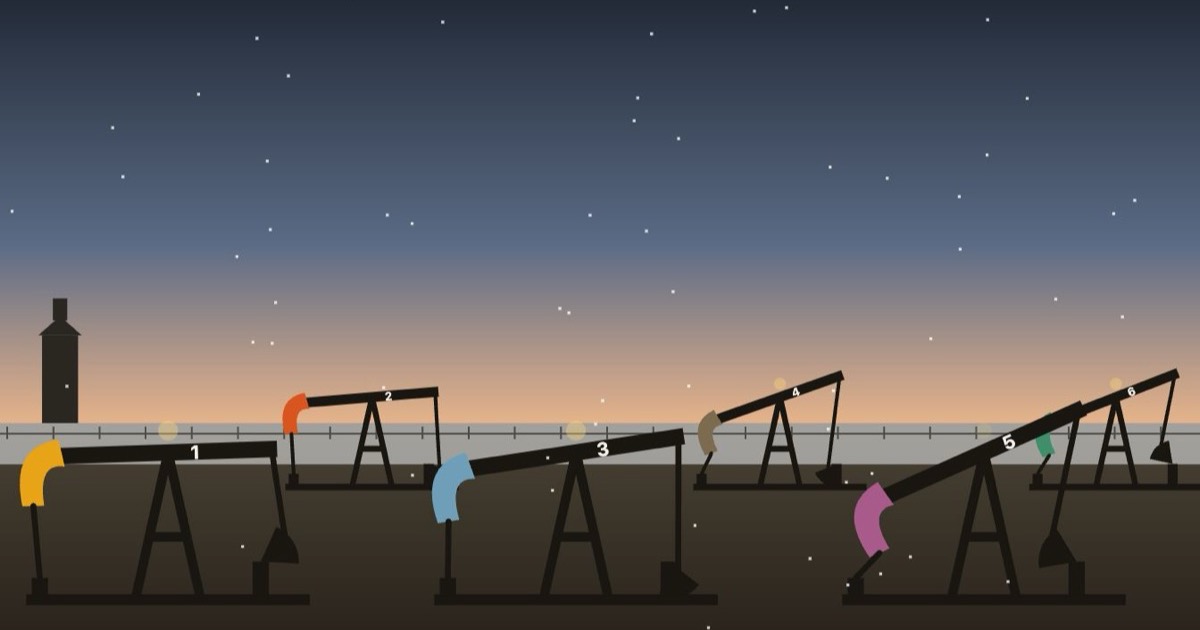
Drum machinelive
The Alberta Jerks
Six pumpjacks on the prairie, each one a voice in an eight-step drum machine.
Light the lamps, press Start the field, and six pumpjacks thump, clank and creak through the beat. Chinook melts the snow and swings the timing. The link holds the whole jam, so you can send it to someone.
- Why we built it
- We had the albertajerks.ca address and nothing on it. An agent built this for it in one day.
- Why it’s a good example
- Every sound is made live in the browser, with no audio files. The whole song lives in the link, so sharing it stores nothing anywhere.
- Made with
- HTML, CSS and JavaScript
- Web Audio
- No audio files
- No tracking
- Live since
- October 2026
Runs on a few dollars a monthUsually quoted around $2,500
-
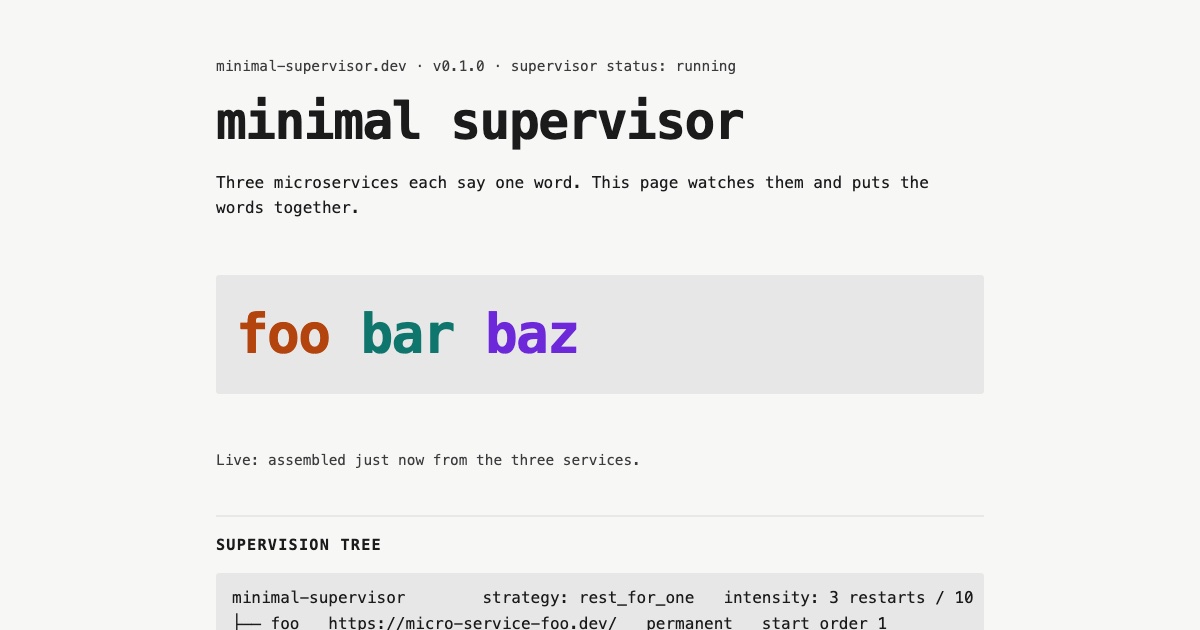
Supervisor demolive
minimal-supervisor.
dev Three one-word microservices, watched by a supervisor that assembles and restarts them.
foo, bar and baz each serve exactly one word. This page watches all three, assembles their words into foo bar baz, and explains the rest_for_one restart strategy it follows if one goes down, with a crash simulator so you can watch it happen.
- Why we built it
- We held four domain names that read like a programmer's joke: foo, bar, baz and a supervisor. An agent designed four small sites that make the joke work.
- Why it’s a good example
- It explains a technical idea by letting you break it. You crash a service and watch the supervisor bring it back.
- Made with
- Four static sites
- HTML and CSS
- One optional script
- No tracking
- Live since
- October 2026
micro-service-foo.devmicro-service-bar.devmicro-service-baz.dev
Projects
Live on the internet.
Products the studio runs, with real users and real uptime to answer for.
-
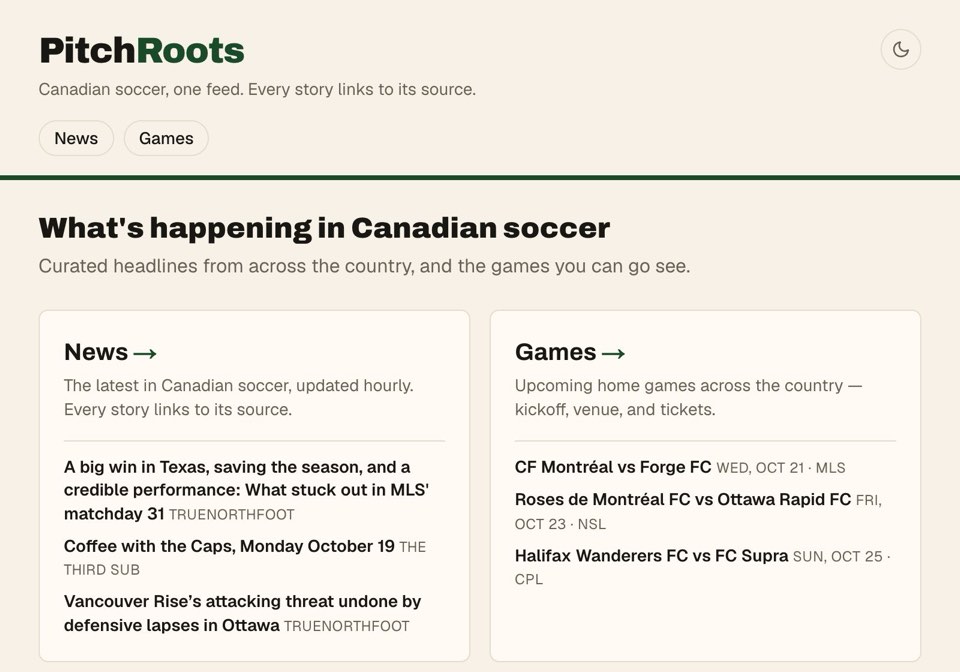
Projectlive
PitchRoots
Canadian soccer, one feed.
Canadian soccer news and home games from across the country, in one feed. Every story links to its source.
- Why we built it
- Canadian soccer news comes from many leagues, clubs and outlets. We wanted it in one place, with every story linking back to whoever published it.
- Why it’s a good example
- A feed that runs itself. Every hour it reads its sources, an AI model sorts the new stories and writes a short summary, and each one is posted to Bluesky. The same engine now runs RinkRoots, a junior hockey feed.
- Made with
- Next.js
- Postgres (Supabase)
- Durable workflows (Resonate)
- Claude Haiku
- Live since
- July 2026
Runs on about $70 a monthUsually quoted around $6,000
-
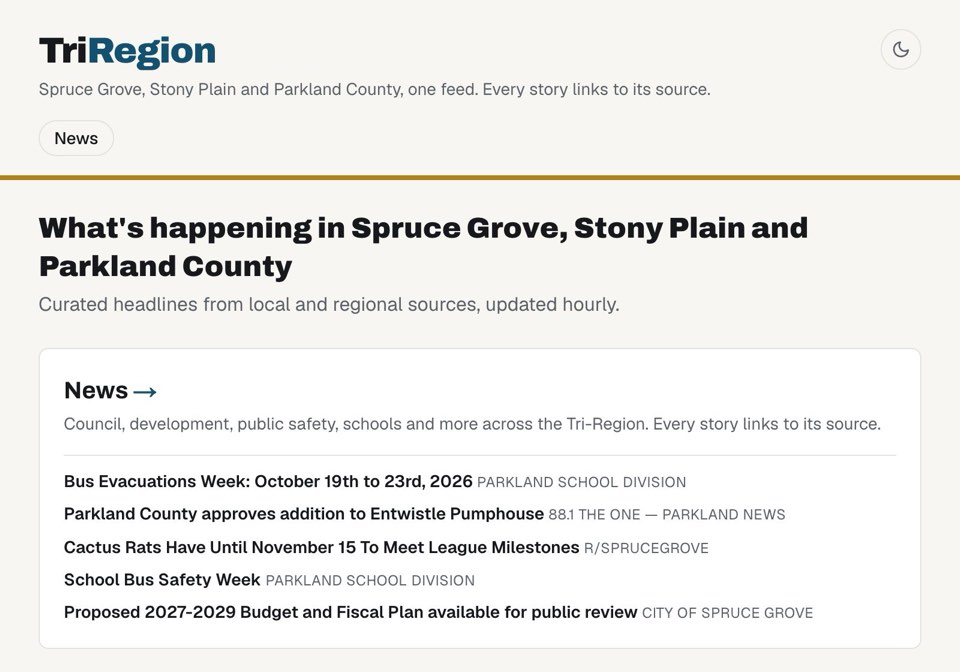
Projectlive
Tri-Region
An hourly local news feed for Spruce Grove, Stony Plain and Parkland County.
Local news for Spruce Grove, Stony Plain and Parkland County. We read the local sources every hour and publish one feed.
- Why we built it
- Local news here comes from the city, the town, the county, council agendas, schools, RCMP releases and local outlets. We made one feed for the people who live here.
- Why it’s a good example
- A free local news site with no ads and no sign-up. It checks its sources every hour, and every story links back to the source that published it.
- Made with
- Next.js
- Postgres (Supabase)
- Durable workflows (Resonate)
- Live since
- August 2026
Runs on about $70 a monthUsually quoted around $6,000
-
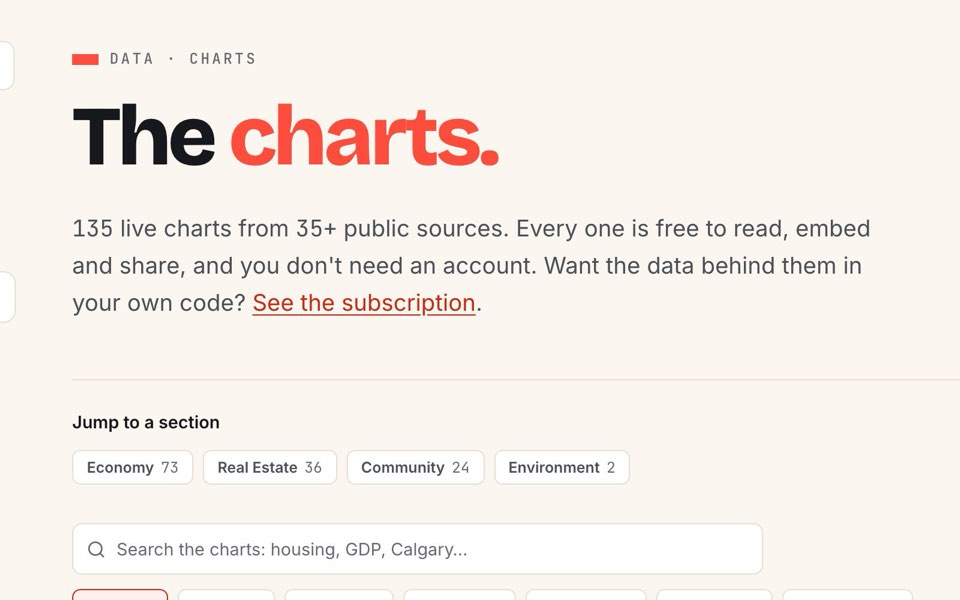
Projectlive
Flossy Data
Free charts and reports on Alberta and Canada, from public data.
Charts and reports on Alberta and Canada, drawn from public sources and kept current. Free to read, no account needed.
- Why we built it
- Public numbers on Alberta and Canada are free, but they are spread across Statistics Canada, the Bank of Canada, CMHC and Alberta's open data. We pulled them into one set of charts.
- Why it’s a good example
- Charts that fetch fresh numbers on their own, with filters by topic and by place. An agent built it and keeps it running.
- Made with
- Next.js and React
- TypeScript
- PostgreSQL
- Recharts
- Data-collection workers
- Live since
- October 2026
Runs on about $50 to $75 a monthUsually quoted around $8,000
Tools
Open source, on npm.
Small tools, each under its own name with its own documentation. They exist because we needed them. Several came out of the agent that runs unattended.
-
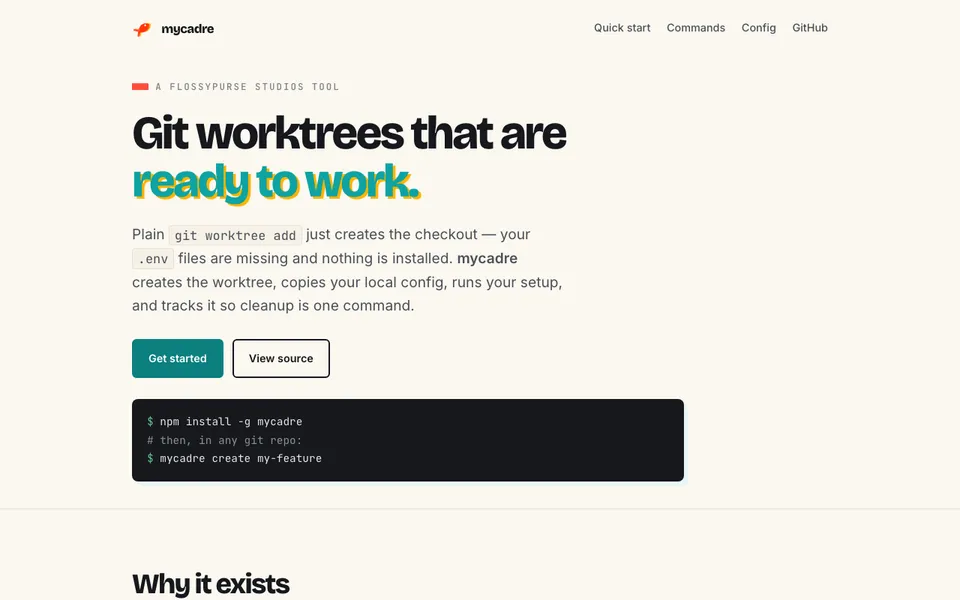
Toollive
mycadre
Worktrees that are ready to work.
A git-worktree CLI. Creates, lists and removes worktrees without the footguns — it refuses to delete work git has not accounted for.
- Why we built it
- We run several AI agents on one repository at once, each on its own branch. Plain git worktrees don't copy env files or run setup, and they leave orphans behind.
- Why it’s a good example
- A small command-line tool with no dependencies that takes a daily chore off a developer's hands. One mycadre.json file configures it.
- Made with
- TypeScript
- Node.js
- No runtime dependencies
- Live since
- August 2026
-
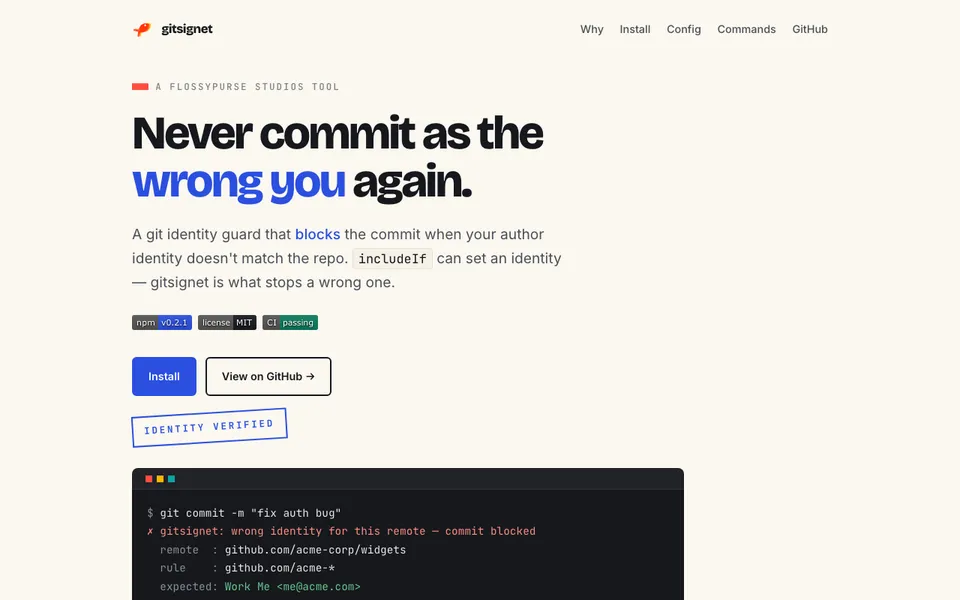
Toollive
gitsignet
Git identity guard.
A git identity guard. Stops commits authored as the wrong person — personal email on a work repo, and the reverse — before they leave the machine.
- Why we built it
- Every commit we make has to carry the right author. Git can set an identity by folder or by remote, but it can't block a commit made under the wrong one.
- Why it’s a good example
- It turns a rule people forget into a check that runs on every commit. When it blocks one, gitsignet fix applies the right identity.
- Made with
- JavaScript
- Node.js
- A git pre-commit hook
- No dependencies
- Live since
- August 2026
-
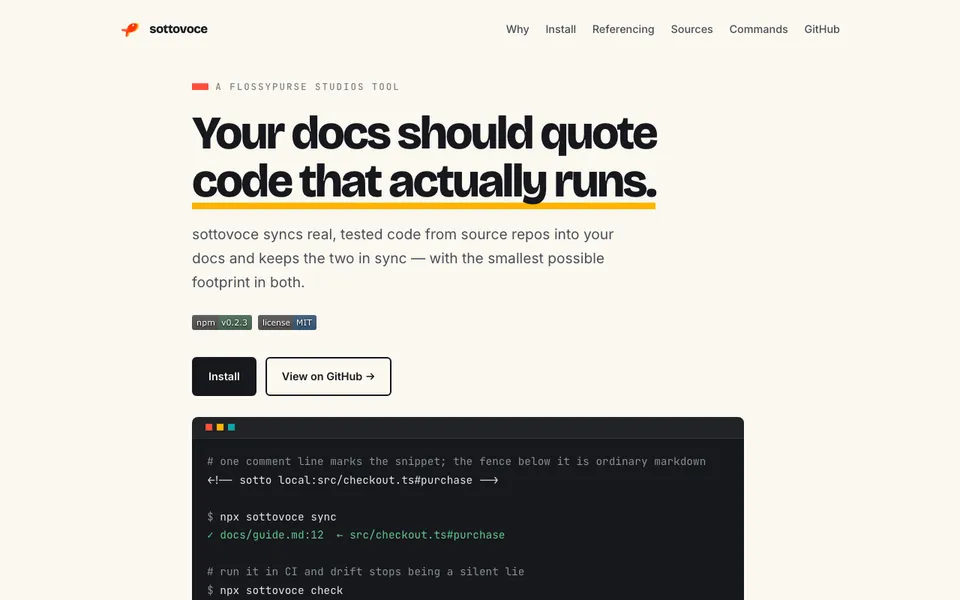
Toollive
sottovoce
Sync real, tested code from source repos into docs.
Keeps the code in your documentation in sync with the code in your repo, and tells you which snippet drifted.
- Why we built it
- Code samples in docs go stale. They work the day they are pasted in, then the code moves on and the docs don't. We wanted docs to quote code that actually runs.
- Why it’s a good example
- Docs tooling that fits into an existing CI. It keeps the code in nine open-source READMEs in sync, and a daily check flags any snippet that drifts.
- Made with
- TypeScript
- Node.js
- One dependency
- Live since
- August 2026
-
Toollive
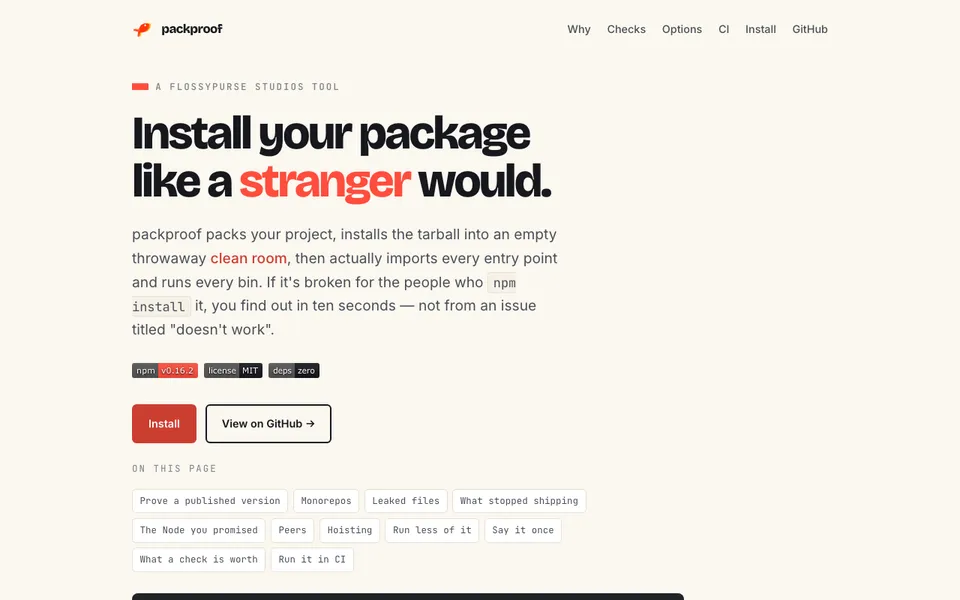
packproof
Install your npm package like a stranger would.
Installs your npm package the way a stranger would — from the published tarball, in a clean directory — and reports what is missing before your users find it.
- Why we built it
- Tests run inside the source folder, where every file exists. A package can pass them and still break for the people who install it.
- Why it’s a good example
- It works on any npm package, ours or anyone else's. It caught one of our own that would have shipped without its command.
- Made with
- JavaScript
- Node.js
- No dependencies
- Live since
- August 2026
-
Toollive
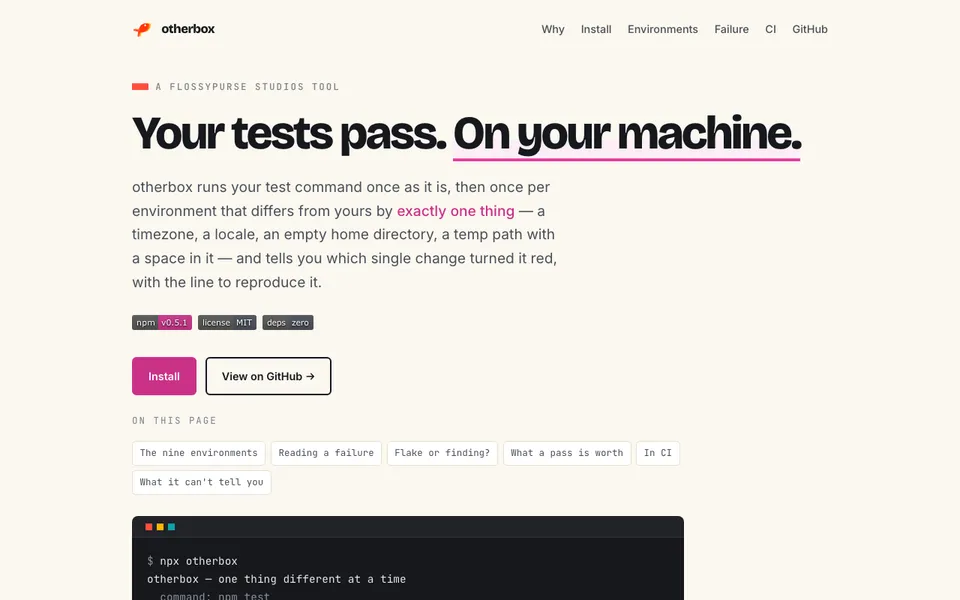
otherbox
Your tests pass, on your machine. otherbox finds where they don't.
Runs your test command once as-is, then once per environment that differs from yours by exactly one thing — a timezone, a locale, an empty home — and names the change that turned it red.
- Why we built it
- A test suite that passes on one machine can fail on another for one small reason: a timezone, a language, an empty home folder. We wanted to find that reason first.
- Why it’s a good example
- It wraps any test command, not only npm test. It names the one change that broke the run and gives the line to reproduce it.
- Made with
- JavaScript
- Node.js
- No dependencies
- Live since
- August 2026
-
Toollive
ledgerlight
Checks that the tests your ledger counts on actually ran.
Reads a test report and checks that every test your loss ledger counts as coverage actually ran, not just that it exists.
- Why we built it
- A loss ledger lists what must never happen to the people software touches, and the tests that guard each one. A test can exist and never run, and a green run still gets quoted as proof.
- Why it’s a good example
- It reads the test reports from a real run and answers loss by loss. A test that exists but never ran is never counted as a pass.
- Made with
- TypeScript
- Node.js
- No runtime dependencies
- Live since
- October 2026